- Mar 26
A Foundational Guide to Locational Astrology and Astrocartography Maps
- Spheres of Fate Astrology
Interest in astrocartography is soaring, as many dream of finding their ideal place in the world. This foundational guide will explore the types of lines on your astrocartography map, explain how relocated charts add to the picture, and clarify the role of cyclocartography- so you can begin to understand the fundamental components of this exciting subject.
Locational astrology is a branch of astrology that demonstrates the impact of place. Astrocartography is a sector of locational astrology that reveals the unique significance locations around the world hold for each individual based on their astrology. Astrologers typically use astrology softwares to generate astrocartography maps (for advanced tools), but some astrology websites have good mapping features as well. It's important to note that astrocartography was founded by Jim Lewis, and many of the topics discussed below are thanks to his work.
Quick disclaimer
Because the concepts used in locational astrology connect to foundational astrological principles, a solid understanding of traditional astrology is needed in order to fully interpret and apply all locational techniques. Getting to know the core tenets of traditional astrology will open up the pathway to becoming proficient in locational astrology. Nevertheless, don't be discouraged by all the factors that go into locational astrology. This topic cannot be learned overnight, but anyone can do it with time and practice!
The four angles
Each astrocartography line on the map is paired with an angle, so it's crucial to learn what each angle symbolizes before decoding astrocartography lines. The four angles on the astrocartography map are the ascendent, descendent, MC, and IC. Each angle represents a major area of life.
The ascendent angle represents an individual's identity, personality, and body. Locations on the map that emphasize this angle are very personal, and contribute to an individual's self-development and outlook on life. This angle is abbreviated as "AC" or "AS" on the map.
The descendent angle represents an individual's relationships, contracts, and interactions. Locations on the map that emphasize this angle are very interpersonal, placing a focus on the people in one's life and socialization. This angle is abbreviated as "DC" or "DS" on the map.
The MC angle represents an individual's career, goals, and public image. Locations on the map that emphasize this angle are very achievement oriented, and contribute to an individual's ambitions and experiences in the public sphere.
The IC angle represents an individual's home, family, and privacy. Locations on the map that emphasize this angle are very reclusive, and contribute to an individual's roots and foundations behind the scenes.
The four angles are explained in more detail in the blog post: "Exploring the Four Angles on Your Astrocartography Map: How Locations Activate Different Areas of Life".
The astrocartography map and astrocartography lines
The astrocartography map is a depiction of your birth chart relocated all around the world. The labels on each line showcase where certain astrological placements of yours are situated in the relocated chart of any given place in the world. Astrocartography lines (often abbreviated as "ACG" lines) are always comprised of an astrological influence and an angle.
For instance, one could have a Mercury Ascendent line going through Chicago, Illinois on their astrocartography map. A generic interpretation can be made for each astrocartography line based on fundamental astrological significations. For example, any type of Mercury line generally signifies socializing, sharing ideas, commuting, commerce, developing new skills or interests, and multitasking- a reflection of the qualities associated with Mercury in traditional astrology. Places influenced by Mercury lines on the map will bring the themes described above into your life.
However, the intricacies of one's unique birth chart will add more nuance and detail to this general interpretation. Continuing the example above, the individual would have to evaluate the condition of Mercury in their birth chart to fully dissect the kind of experience they would have near a Mercury line. The condition of the planet is dependent on concepts in traditional astrology such as dignity, sect, and aspects. Previous blog posts about Venus lines and Neptune lines explain this nuance in further detail. Essentially, it is best to consider lines on the map that highlight the most well placed planets in your birth chart, which will be different for everyone. For some people, the Sun will be the most supportive planet in their chart, for others Uranus may be their best option, etc. Overall, astrocartography lines are one of the primary factors to consider when evaluating a location, as they are extremely powerful.
Key points:
Astrocartography lines are labeled with two symbols, one representing an astrological placement and another representing an angle.
Astrocartography lines appear as vertical and curved lines across the map.
Planets aren't the only astrological placement paired with an angle on the astrocartography map. The lunar nodes (the north and south node) and asteroids are also paired with angles across the map.
You have to be in orb of astrocartography lines in order to notice the effects. A range up to 700 miles is the standard rule. This means any location within 700 miles of an astrocartography line is in the orb of influence and will reflect the themes the line represents.
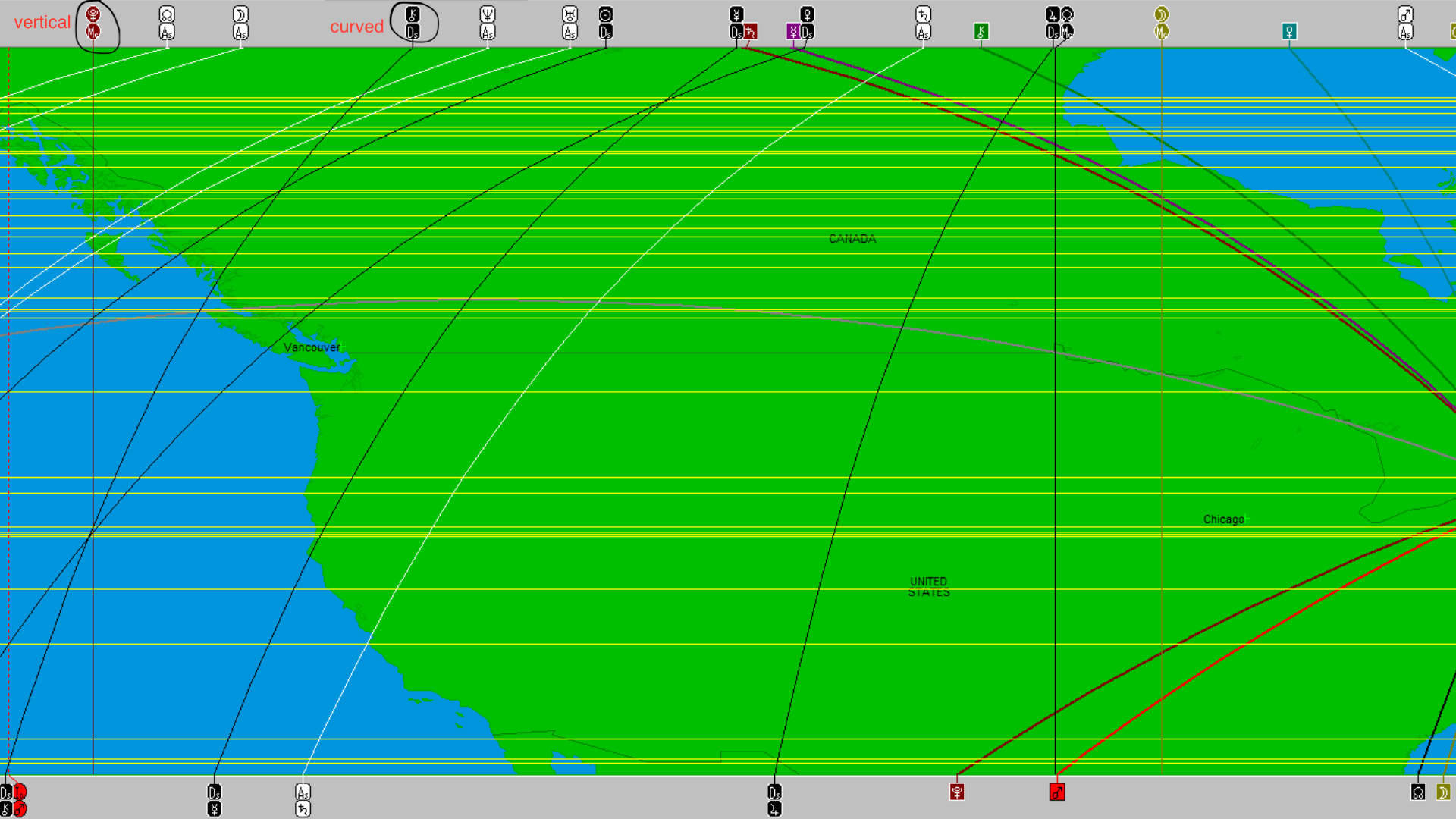
Astrocartography lines on the astrocartography map.
Parans
Parans (also known as latitude crossings) are lines that form when two astrocartography lines intersect on the map, creating a new combined influence. For example, when a Moon Descendent ACG line crosses paths with a Mars Ascendent ACG line, a Moon-Mars paran is formed. Notice that parans do not combine the influence of the angles, just the planetary influences (the same thing goes for asteroids and lunar nodes, as they are included in paran combinations as well).
A generic interpretation can be made by combining the fundamental astrological significations of each influence in the paran. For example: a Mars-Neptune paran combines the influence of Mars and Neptune, and is therefore associated with themes such as frustrating aspirations, creative activities, spiritual motivations, selfless acts, aimlessness, and confusing conflicts. Mars is a malefic planet in traditional astrology that represents action, willpower, and conflict. Neptune is a neutral planet that represents transcendence, ideals, and imagination. Together, these planets indicate a wide range of hazy and heated experiences.
In Jim Lewis' book, The Psychology of AstroCartoGraphy, he suggests that parans are seen as more of a neutral influence given their makeup, as they are the byproduct of two other influences. This would imply that astrologers can interpret parans based on general astrological principles without also considering the natal chart. Ultimately, each astrologer is entitled to their own decision in consulting the natal chart or not when it comes to parans. Parans are one of the primary factors to consider when evaluating a location, as they shape one's experience greatly.
Key points:
Parans are labeled with two astrological symbols, representing a dual influence.
Parans appear as horizontal lines across the astrocartography map.
You have to be in orb of parans in order to notice the effects. A range up to 70 miles is the standard rule. This means any location within 70 miles of a paran is in the orb of influence and will reflect the themes the paran represents.
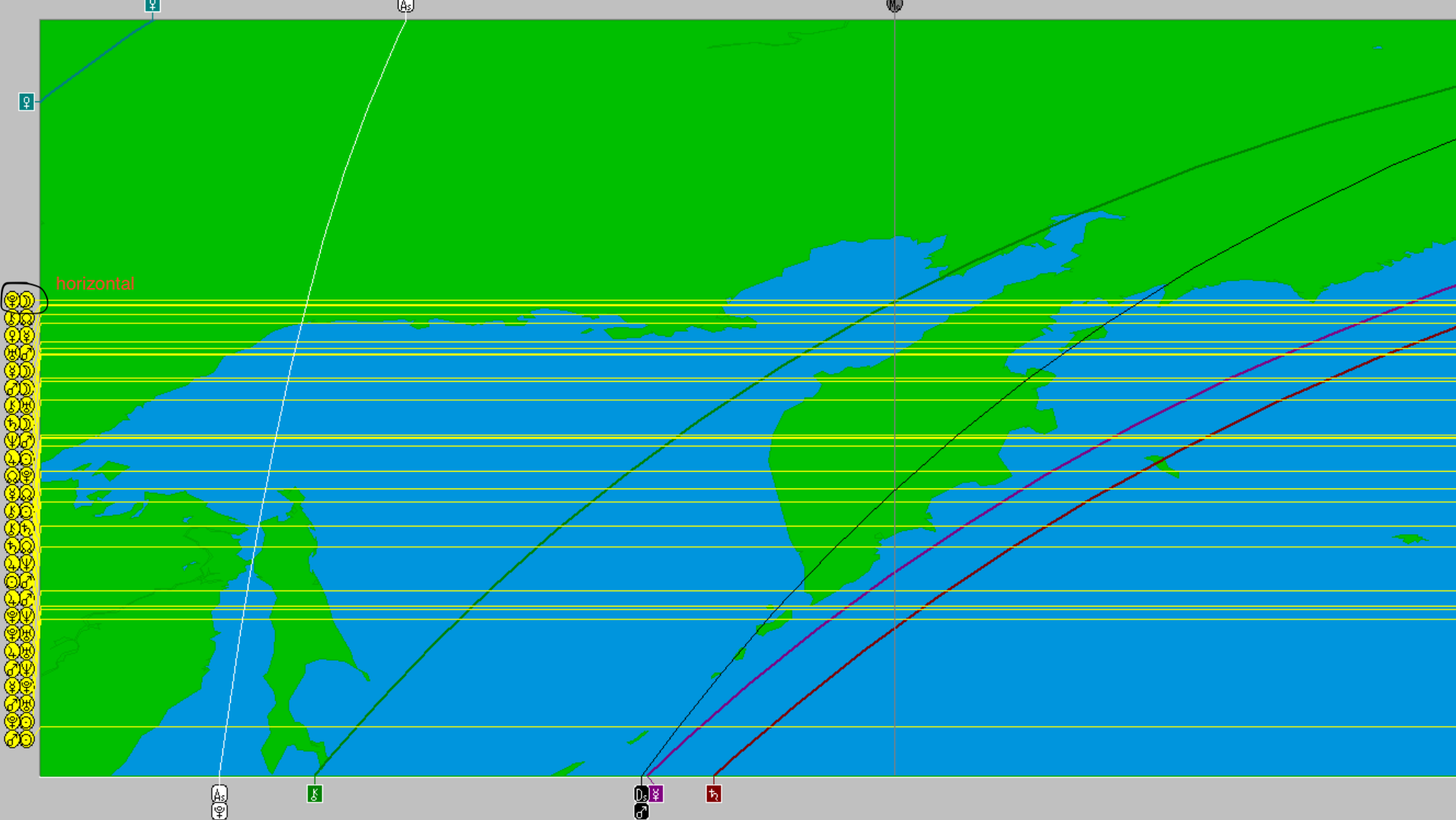
Parans on the astrocartography map.
Local Space Lines
Local space lines depict the planetary directions on the horizon from the perspective of the individual’s birth location. These lines are intepretated much like ACG lines, as astrologers must evaluate the generic significations of the planetary influence in addition to the condition of the planet in one's natal chart. For example, Venus local space lines are generally considered positive, as Venus is a benefic planet in astrology that represents topics such as love, leisure, and creativity. However, if an individual has Venus in Virgo in their birth chart (a fallen position that indicates more difficulties with Venusian matters), visiting locations affected by Venus local space lines on the map will exasperate existing challenges in these areas. Though local space lines are not one of the primary factors to consider when evaluating a location, they are important to consider and note when comparing locations.
Key points:
Local space lines are curved lines on the map with just one planetary label.
Local space lines emerge from your birth location and expand beyond that point.
Unlike parans and ACG lines, local space lines aren't measured in distance. Local space lines are measured by direction. Thus, you have to be in the direction of the local space line to notice the effects.
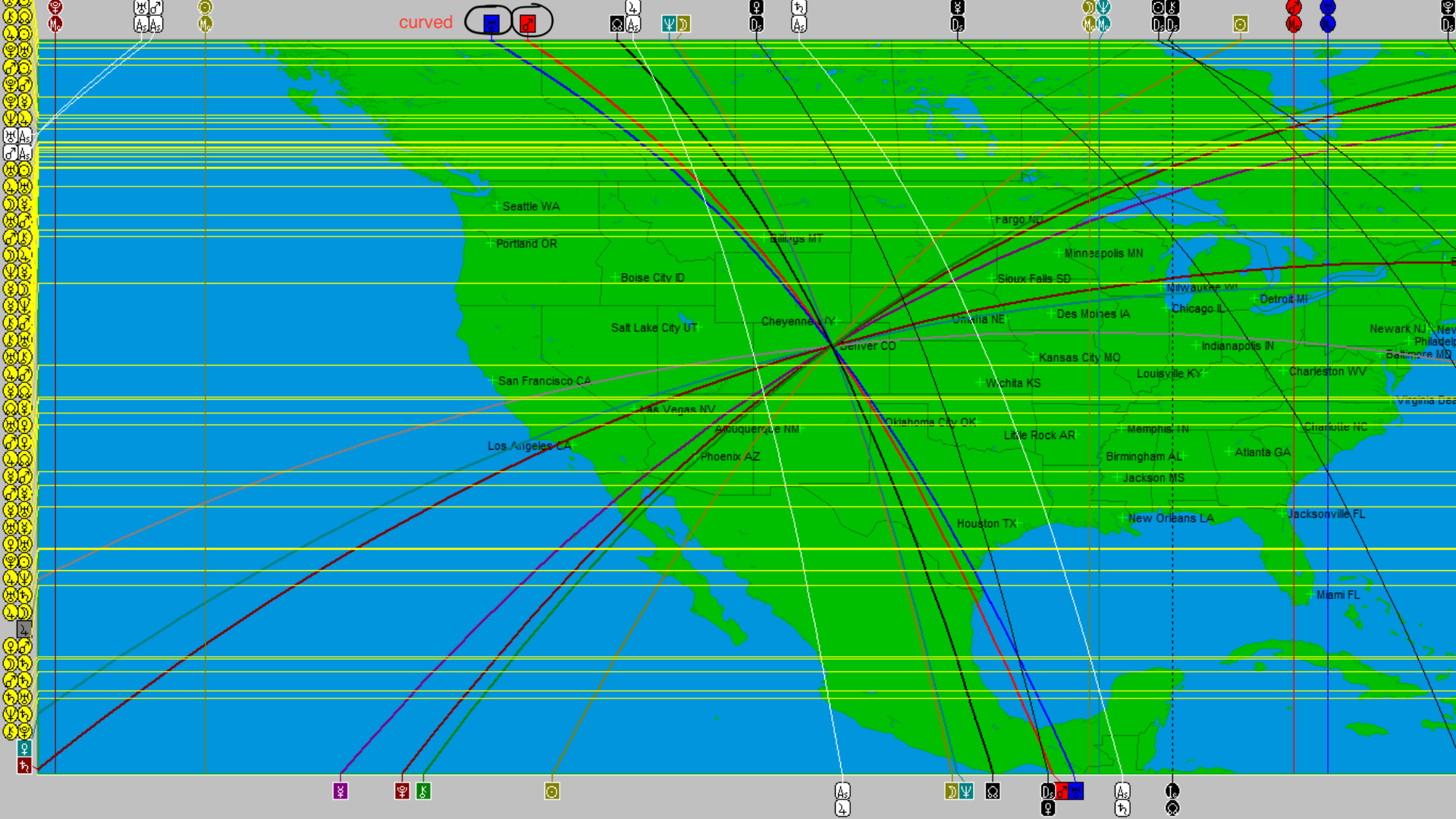
Local space lines on the astrocartography map.
Relocated Charts
Relocated charts depict the cosmos on the date and time of your birth and replace your birth place with the new location of your choosing. Relocated charts look nearly identical to your birth chart, as only the angles and the aspects to the angles change. Keep in mind that the shift of the angles naturally switches the house placement of the planets in your chart.
A relocated chart represents how each area of one's life transforms with relocation. For example, a signature that indicates an isolating lifestyle in one's birth chart (such as a stellium of planets in the 12th house of isolation) could shift to a more social lifestyle in a new location (due to that same stellium of planets shifting to the 11th house of community in the relocated chart). Relocated charts are one of the primary factors to consider when evaluating a location, as they reveal how pieces of the individual's current life will reshuffle.
Key points:
Your relocated chart for any given location around the world looks similar to your birth chart, only the angles and aspects to the angles will change. The house placement of your natal planets will naturally change as well due to the shift in angle.
The relocated chart showcases which aspects of your consciousness and life circumstance become more pronounced in a new location in contrast to your current experience.
The relocated chart is an additional influence, it is not interchangeable with your birth chart. Your birth chart remains the same for life and is always active.
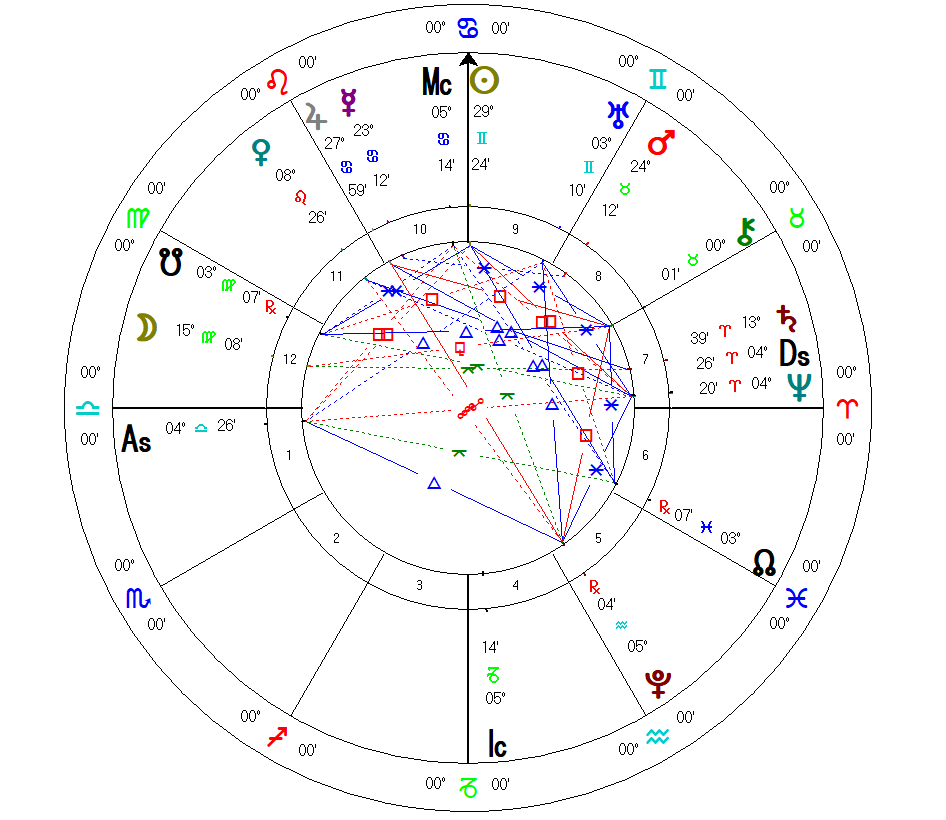
Example of a relocated chart.
Cyclocartography
Cyclocartography refers to the timing component of relocation in astrocartography. Astrology softwares can display astrological transits and progressions across the astrocartography map to show where future astrological influences will transpire in the world. For example: traveling to a location at a time when a Venus progression is moving over the area will activate fun, pleasurable, and fortunate experiences in that location.
One may have specific wishes for their travels or relocations. For example, an individual may want to move to a location to boost their career success. In this case, the individual would want to relocate when a positive transit or progression moves across their chosen location. If the relocated chart has a Pisces MC, they could move to this destination when Jupiter transits the sign of Pisces to enhance opportunity.
Supportive transits or progressions that impact the relocated chart in a pronounced way signal a time period of greater ease. Though it is not necessary to time your travels or relocation strategically, it is an incredibly helpful way to ensure that you are going to your chosen location at the most opportune time.
Key points:
Cyclocartography lines are labeled with an astrological symbol and an angle, representing an astrological transit or progression moving across the map as time moves forward. Cyclocartography utilizes the inner planet's progressions and the outer planet's transits.
Cyclocartography lines appear as vertical and curved lines moving across the map as you click on the features that fast forward time.
You must travel or relocate when the cyclocartography line is in orb of your chosen location in order to notice the effects. A range up to 700 miles is the standard rule. This means any location within 700 miles of a cyclocartography line is in the orb of influence and will reflect the themes the cyclocartography line activates.
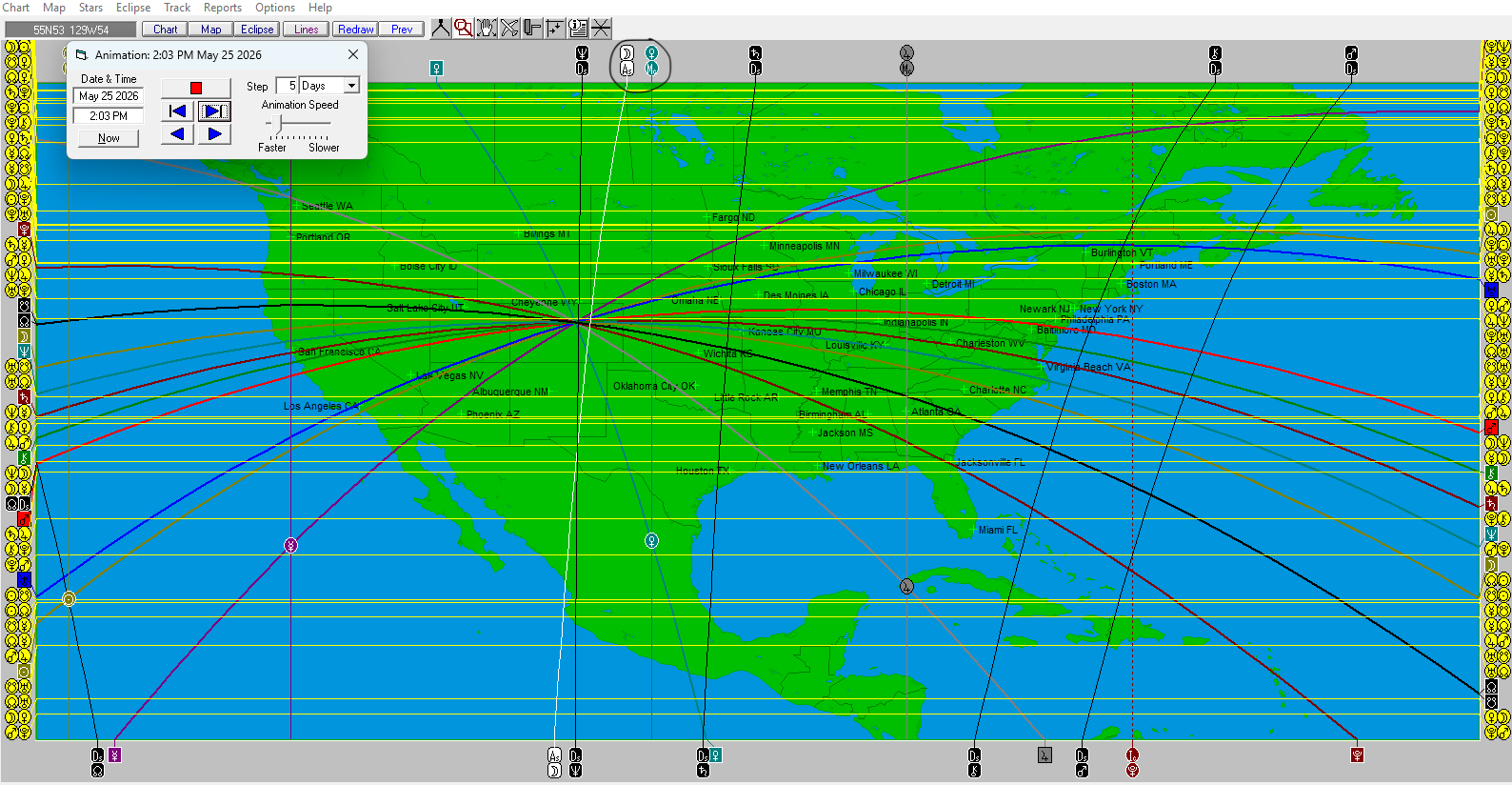
Cyclocartography lines on the astrocartography map. The curved and vertical lines will move across the map as you press the animation forward in time.
The role of preferences
The goal is to find locations that are the most supportive astrologically and best suited for the individual's intentions. One's preferences can factor into an astrologer's search in locational astrology. Every individual is unique, some may be looking for a location that keeps them busy and social, while others may be looking for a location that evokes relaxation and solitude. Imagine that an individual wants to move to a location that will enhance their career as a professor- an astrologer may consider Sun MC lines on the astrocartography map to emphasize their public recognition and leadership or Jupiter MC lines to promote themes of opportunity and teaching. Remember, the MC angle highlights one's career. Some of the general astrological significations of the Sun are visibility, purpose, and ambition- all of which are relevant in this scenario. Some of the general astrological significations of Jupiter are luck, knowledge, and expansion- all of which apply to this context too.
Sometimes the planet that is most relevant to an individual's preference is not a supportive planet in their birth chart. For instance, perhaps someone wishes to build a family, in which case a cozy Moon IC line would be most fitting. However, if they have a Scorpio Moon in their natal chart (in a fallen position- which indicates challenges) and it's in square with Saturn (a harsh aspect with a malefic planet), it would be wise to consider other possibilities for this individual. The reason behind this is locations influenced by Moon lines would carry the same heavy themes found in the natal chart's difficult configuration: themes such as emotional burdens, familial struggles, and a lack of support. Suppose this individual's Venus is in great condition in their birth chart in the sign of Libra. In this case, Venus IC lines would better support their wishes. The Venus IC line would still emphasize a desire for tending to home and family matters in a loving way, though in a manner that comes without as many challenges as Moon IC lines would bring the native.
Conclusion
After noting the factors mentioned above, astrologers must put together every piece of data to narrow down the locations on the map. Ultimately, understanding your astrocartography map or getting a professional reading is an effective way to ensure you are choosing a travel destination or place of living intentionally, one that supports your best interests.
Book an astrocartography reading here for an evaluation of your specific map.
Credits:
Photo: © Canva via Magic Media AI
References: The Psychology of AstroCartoGraphy by Jim Lewis
Relocated Chart and Astrocartography Maps: © Solar Fire